Standard batteries
Two AA cells. Sold on every continent, in every corner store, for the last 70 years — and the next 50. No proprietary pack to age out and take the device with it.
2× AA · CS4313 DAC · No cloud
Chargers die. Clouds shut down. The Doomsday MP3 runs on two AA batteries — for the next 50 years.
Target price: $49.99 · No deposit required
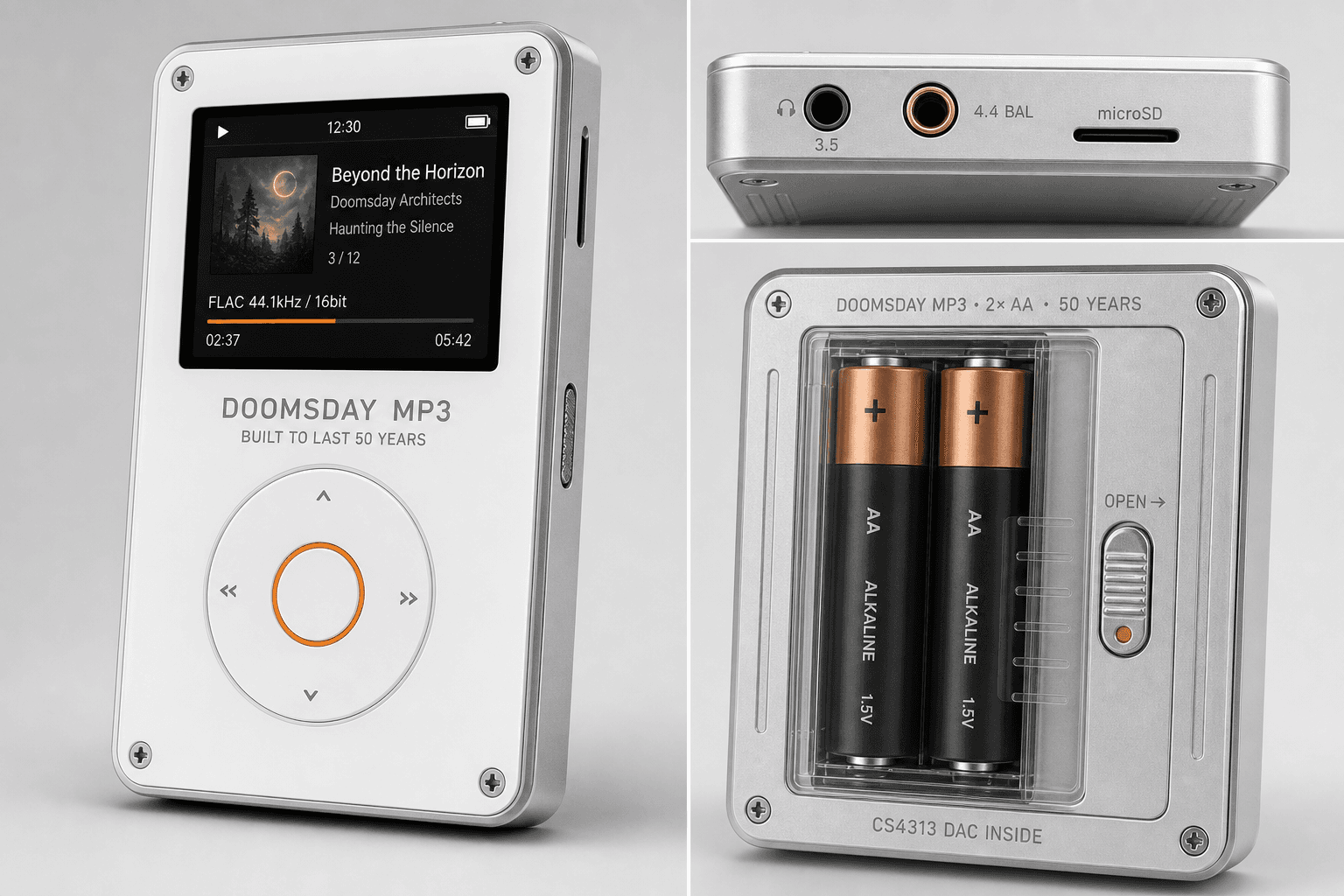
The 50-Year Promise
Two AA cells. Sold on every continent, in every corner store, for the last 70 years — and the next 50. No proprietary pack to age out and take the device with it.
Exposed screws, no glue, no sealed unibody. Every wearing part can be opened, inspected and replaced. If it breaks, you fix it — you don't bin it.
No app, no login, no firmware server to go dark. Your music lives on a microSD card and comes out of a headphone jack. Nothing here can be shut down remotely.
Why AA?
Every sealed lithium battery is a countdown timer: a few hundred cycles, then a bloated pack and a dead gadget. Replaceable AA cells reset that clock every time you swap them.
Gas stations, supermarkets, vending machines, emergency kits. AA batteries are the most distributed energy format on the planet. Your music player should speak it.
No cable to forget, no port to wear out, no overnight ritual. Ten seconds with the thumb latch and you have weeks of playback again.
USB connectors change shape every decade. The AA cell has kept the same form factor since 1947. That is the kind of standard you build a 50-year device on.
Features
A dedicated Cirrus Logic CS4313 converter — clean, quiet output instead of a vague hi-fi promise.
MP3 today; FLAC, WAV and APE are the target formats for the shipping firmware.
The universal jack for every headphone ever made, plus a balanced output for the serious ones.
Your entire collection on a card you own. Swap it, back it up, move it — no syncing, no DRM.
Wireless earbuds work too. But the wired path is the one designed to outlive every protocol.
Operate it blind: in a pocket, on a run, with gloves on. Fewer fancy parts, fewer failures.
Two AA cells mean long playback without daily charging — swap them anywhere on Earth in ten seconds.
A clear polycarbonate slide cover. One push of the thumb latch and the batteries are out.
Specs
| Target price | $49.99 USD |
|---|---|
| DAC | Cirrus Logic CS4313 |
| Power | 2× AA batteries (3V), alkaline or NiMH |
| Audio formats (target) | MP3, FLAC, WAV, APE |
| Storage | microSD card |
| Wired output | 3.5mm single-ended · 4.4mm balanced |
| Wireless | Basic Bluetooth for earbuds |
| Controls | Physical click wheel, blind-operable |
| Construction | Aluminum chassis, screwed — not glued |
| Design target | 50-year service life |
Pre-production targets. Final specifications will be confirmed after prototype validation — that's what the waitlist is for.
FAQ
Yes. The Doomsday MP3 is designed for both alkaline and NiMH rechargeable AA batteries. Any two standard AA cells will power it — that is the whole point.
Two AA cells provide 3V, enough headroom to drive the CS4313 DAC and the balanced 4.4mm output properly. AA batteries are the most widely available power source on Earth, and they will still be on shelves in 50 years — unlike proprietary lithium packs that degrade and get discontinued.
By removing everything that normally kills a gadget: no glued-in lithium battery to age out, no companion app to lose support, no cloud service to shut down. The chassis is screwed together, not glued, so worn parts can be replaced. 50 years is our design target, and every engineering decision is made against it.
A dedicated Cirrus Logic CS4313 DAC handles digital-to-analog conversion, delivering clean output to both the 3.5mm single-ended and 4.4mm balanced headphone jacks.
The 3.5mm jack works with virtually every pair of wired headphones ever made. The 4.4mm balanced output serves higher-end headphones with more driving power and lower interference. Wired output is a protocol that cannot be deprecated.
Yes, basic Bluetooth for wireless earbuds is planned. But the wired jacks are the long-term path: they will keep working long after today's Bluetooth versions are forgotten.